
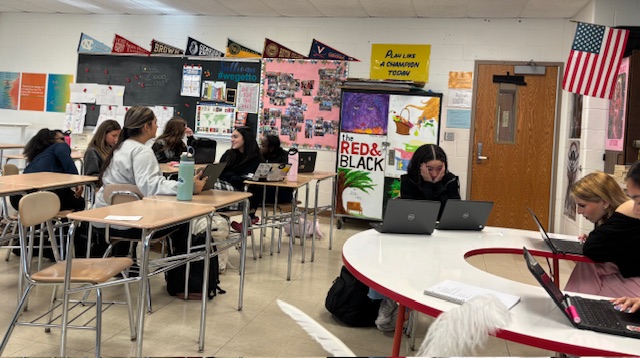
So much of a teenager’s life is structured and planned for them before they even get a chance to speak up.
“Take these classes,” “Learn this course to graduate,” “This is what you should study.” Such little choice takes away the small freedoms a young student gets. But what if there was an outlet for kids to explore any interest they desire?
Journalism, a course that gives students an opportunity to tell stories relevant to their own lives and communities. Instead of being scheduled to take an extra elective that doesn’t interest them or being left with a study hall that feels more like wasted time, journalism can act as an outlet of self-expression.
Students can write about a favorite sport their school played last night, or film a segment walking around their town explaining their favorite niche history facts. Kids can become co-anchors with their best friends, attend school events to report on, or form a friend group while filming a video to be posted on their school’s newspaper website.
Journalism teacher Andrew Simmons explains the creative advantages of a journalism course in his own 2022 article on Edutopia. Simmons recites the variety of article types—news stories, opinion pieces, profiles, narratives, and investigation— and how they can bring out the artistic side of students.
Giving kids a topic to report on, to put an exciting spin on something that seems tedious at first glance, work skills that go unnoticed in standard core classes. Being able to walk into a room full of stranger and snap photos, sit down with an older authority figure and hold a conversation, or collaborate with 10+ people on a cohesive project.
These skills aren’t taught in a common curriculum class, but they’re vital for functioning in the real world.
Simmons also writes, “Students have the freedom to explore and the understanding that they’ll be rewarded if they do.” Whether that reward comes in the form of extra credit or being recognized as an intern or community service worker, journalism allows students to fill up their resume with activities they genuinely enjoy.
Jobs and universities want passion; they’d rather receive an application full of articles and segments that have hours of dedicated care behind them compared to a few clubs the recruit attended twice.
Journalism fuels passion. It’s a wide field with a place for everyone, allowing students to find their niche and explore it. Students can refine their soft skills while discovering parts of themselves that would have gone unnoticed.
The article ends by adding that “committing to authentic projects” reminds both students and teachers that school can be more than “I can” statements and busy work.
“Ambition is contagious,” Simmons states. The more involvement a journalism class gets, the more kids will get the opportunity to develop out-of-the box ideas. Adding a class that evokes the creative spirit often lost in education today gives students a new outlet for self-expression.
In a world where work and stress are more connected than ever, combined with the influx of generative AI, journalism sticks out as an opportunity for kids to create a type of craft long forgotten by their school schedules.
The Humanities Department is one constantly overlooked, but a course in Journalism would bring eyes back to the very thing responsible for music, art, literature, and so much more.
In today’s world especially, students of all ages could always use more outlets for artistry.






Tracy Falkner • Jan 24, 2026 at 7:36 pm
Great article. Critical thinking needs to be developed. I’m going to encourage my daughter to participate.
Robert Falkner • Jan 24, 2026 at 6:07 pm
We need to develop more critical thinkers. Thanks for sharing.