On February 13th, the Red and Black attended Adelphi University’s annual Press Day and Quill Awards, where we listened to a panel regarding the uses of Artificial Intelligence in journalism, and we left the university that afternoon puzzled. At the panel, we were told to use AI to our advantages, but with our previous knowledge of AI and what we gathered at Press Day, we believe it is of incredible importance to share the damage AI has been doing to countless creative fields.
AI in Journalism
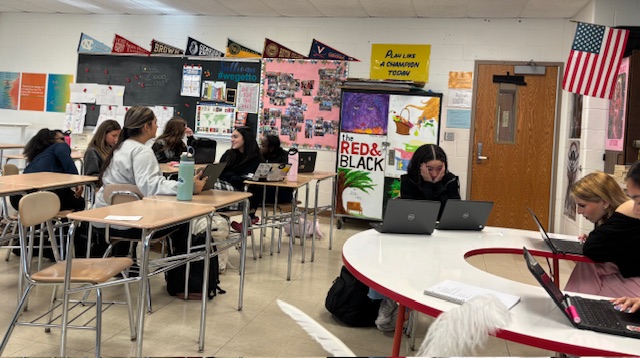
At Adelphi University’s annual Press Day and Quill Awards, the Red and Black, along with newspaper and broadcast groups from other local school districts, had the opportunity to delve deeper into the craft of journalism with some of the leading names in the field. We heard from the keynote speaker, Joye Brown, an award-winning journalist for Newsday, stood audience to a productive panel discussion, and engaged in more intimate workshops.
One would imagine that this experience would have been extremely beneficial; that much wisdom would’ve been gained regarding journalism techniques, writing skills, and navigating journalism in today’s world.
Rather than a meeting of minds of green, grinning student journalists who longed to improve through the guidance of award-winning professionals, this conference was nothing but an advertisement for AI integration in journalism.
AI is an immediate threat to the future of the Humanities and other creative fields. According to Microsoft researchers’ comments to Fortune magazine, Journalists and Reporters rank comfortably in the top 20 jobs most affected by AI. This panel seemed to accept that fact despite the threat to their own field.
Brown argued further that integrating AI would be beneficial for if not the actual writing of the article, then for compilation, for brainstorming. Just the same, is that not part of the job, part of the craft? Why sacrifice that skill, purpose, and creative duty at the hands of an inaccurate, inanimate, unpaid, impassionate, unnecessary machine? The research, brainstorming, interviews with real-life people, flying to distant locations to experience events firsthand; that is a part of journalism and always has been. AI does not have to do it for us. If Pulitzer Prize-winning journalists can write successfully without AI, as they have in the past, if student journalists can write successfully without AI, then it begs the question, who exactly needs AI in journalism? Because it doesn’t seem to be the journalists.
One has to inquire, why are these career journalists pushing to take away the creativity of the craft? They say AI is the future—that’s not true. The future is us, the student journalists. From what I witnessed at the Adelphi conference, it seems as if the future has spoken: there is no place for AI in journalism.
AI in Academics
Is the use of AI for homework truly worth the risk of permanently harming intellectual behaviors?
No, it is not. Adolescents have become reliant on using AI to complete even the smallest homework/classwork assignments which are significantly affecting critical thinking skills and undermining fundamental development skills. Along with homework and essays, AI is used to write emails and send letters, causing a lack of originality and decreasing strength in writing skills.
The dependency of AI platforms, most popularly Chat GPT, is also entirely connected to lower reading levels and decreased test grades across the country. Lasherica Thornton, who covers education in California’s Central Valley wrote an article using data from a performed experiment, stating that “according to The Hechinger Report, students utilizing artificial intelligence programs did worse on math tests than their peers without access.”
Students are lacking the ability to analyze complex problems and problem-solving techniques strictly due to AI doing it for them. With the generation of AI, the world is becoming dull and incapable of skills that have been done for centuries.
It is time to enforce more restrictions on the use of AI overall, but especially in educational settings. Societies continue to progress with technology, but there needs to be a level of balance between robotics and humanity and a greater preservation of creativity and culture.
Generative AI Art
With AI chatbots taking over our ability to think critically and make informed decisions, it also inhibits our ability to create.
Similarly to asking AI to do your homework, you can also prompt it to create images or graphics without learning the intricacies of digital media or by putting pen to paper. This may seem like an effective way to save time, but a major pillar of every artform is the creative process and the expression of ideas; digital and print art allows you to utilize the crevices of your imagination to create something with immense meaning and purpose.
Artists spend years perfecting their craft and learning how to communicate through various mediums, and AI art has dismantled our idea of what qualifies as art. The laziness of feeding a prompt into a lifeless generator is also a major threat to the livelihood of those who create for a living, neglecting to compensate artists who’d normally design graphics or illustrations.
Think about the most famous artworks in the most prestigious museums: they all evoke certain feelings and make statements that AI art cannot replicate. AI can only reconstruct existing artistic ideas, having no ability to create anything with groundbreaking intentions or substance.
Hopefully, humanity will prevail, and AI generated “art” will be unable to stand the test of time the same way as the artforms humans have admired for centuries.
AI in Media
“You’ll either get it or pretend you don’t,” says Tilly Norwood, the world’s first AI “actress.”
It seems to think that the integration of AI into all aspects of film media is unavoidable, and highly achievable in the foreseeable future.
This is ironic, considering it has no mind to think about anything at all.
AI becoming prevalent in Hollywood serves as a major threat to aspiring, as well as current actors everywhere. Just think back to the 2025 Academy Awards, when Adrien Brody was awarded the Oscar for best actor in a leading role.
His role in The Brutalist utilized AI technology to perfect a Hungarian accent that Brody could not perform himself. As for the other nominees? Raw, authentic performances. The most artificial thing about them was mostly likely the makeup on their faces.
Watching artificial performances beat out meticulously rehearsed talent should be a wakeup call for professionals in the field and audiences alike. Are we willing to reduce creative filmmaking to something that can be curated with a couple clicks?
AI generated media dilutes the industry; it strips accredited creators of their accolades, all while promoting its use to the public as a natural step in technological evolution.
There is no doubt that the abuse of AI-generated media will expand beyond the confines of filmmaking. Notice how you can’t conduct a Google search without the first result as an AI overview.
Social Media platforms such as TikTok and Instagram have incorporated AI responses into their search engines as a way of providing quick, concise replies to inquiries through the engine. This not only pollutes our apps but immediately steers users away from real content that features real creators.
With such advancements in AI showing tremendous growth just within the past year, the threat is crystal clear. The use of AI in all aspects of the media serves as a weapon against creators. Even Time Magazine deemed their Person of the Year 2025 as “The Architects of AI,” a title that had historically been given to a real person of influence and character.
Maybe it’s overdue that these “architects” take a break. Let’s place control of the media back into the hands of those experienced to do so.
At the very least, into real hands that have fingers, not keypads.
AI in Music
Is AI the future of music, or a threat to human creativity?
Imagine a future where your favorite song is composed not by a human, but by an AI chatbot. The music industry is on the rise with a seismic shift towards AI, designed to redefine how we create, produce, and even experience music. Artificial intelligence continues to revolutionize music by recomposing original pieces and aiding in the development of other production tasks, ultimately opening new creative possibilities for musicians.
This shift changes how music is made, while also raising significant inquiries about authorship, copyright, and the diminishing role of human creativity in this increasingly complex industry. It is important to consider the potential challenges that will come from the development of Artificial Intelligence in music.
As AI evolves, it also presents challenges regarding the ethical use of Artificial Intelligence, the lack of versatility in musical artists, and legal perspectives that must rapidly change in order to ensure that the benefits of AI are shared fairly.
As AI offers tools for creation and production, the rise of artificial intelligence creates concern for the lack of human feeling and the loss of the symbolic relationship between human artists and their passion for music. And if AI becomes more capable of generating higher quality music, it will likely disrupt the traditional music industry as the demand for human musicians decrease.